Friday, June 19, 2009

A New Home, New Language, New Culture

Seeking out research opportunities in my field has brought me to McGill university, located in the beautiful city of Montreal, Quebec. I wouldn’t have believed you, had you told me a few years ago that I would be here now. That said, it has not been overly difficult to get adjusted and settled in here. While the primary language here is French, Anglophones have little difficulty navigating, speaking with locals, and basically doing anything, as most people here are bilingual. I’m told that it is in fact difficult to learn French here as if you have any sort of Anglo accent, people revert to English. My 9th-grade French education has come into use, but has by no means been essential.

While it is taking me some time to adjust to the rapid-fire pace of downtown in a major urban centre, the noise of constant traffic outside my bedroom and a general attitude of disinterest by passers-by that I’m not used to, I’m beginning to get settled in, used to things, and comfortable.

I expect I will have a lot to offer up about this fine city in the future. For now, I’ll leave up a photo of downtown Montreal, as seen from Mont-Royal, the city’s namesake.

DSC08326_edited

Friday, June 12, 2009

I know you’ve missed me…..

Well, I’ve let this page grow stale with time and so I suppose anyone who was reading once upon a time has left, but I’ve been inspired to get the ball rolling and start writing again. As I used to write about my escapades in Europe last summer, I’ll need to change gears a little, and figure out how I want to continue with this space. That said, I still have some great pictures to share. For now, I’ll just post a current desktop wallpaper of mine that I really like, dug out of my photo archives from last August.

DSC06750_edited-1Figure 1: The white cliffs of the island of RĂ¼gen

Tuesday, February 3, 2009

Talking Babies

From a recent SciAm article on the origins of speech:

[Recent commercial] is only the latest proof of what comedians have known for years: few things are as funny as a baby who talks like an adult.

Am I the only one that finds ads/movies featuring talking babies to be incredibly disturbing?

Sunday, February 1, 2009

Philosophical Solutions to Scientific Problems

So a couple of days ago I went to a talk by this guy:


It turns out that it is not only possible to have three Ph.D.'s in different disciplines, but to actively research in all those at one time as well. Unless you're a Nobel Laureate, this guy likely makes anyone feel like an underachiever. "You only have two Ph.D.'s? That's nothing. Massimo Pigliucci has 3."

Dr. Pigliucci's talk was on the intersection of philosophy and science. He talked on scientific versus nonscientific disciplines, the limits of science, the application of philosophy to scientific ideas.

An important thing that I took away was an understanding that I really do not know very much about philosophy. I guess that is the price I pay for taking intensive science-based courseloads to expand my depth of knowledge in the sciences, specifically molecular sciences; I've sacrificed breadth. Most of my knowledge concerning critical thinking and logic have come from sources outside of my academic career, and of course these don't get nearly as in-depth as postsecondary courses would into the subject matter.

An interesting example that I took away from his talk, while not unknown to the scientific community, was largely ignored by myself until present. The definition of species is in fact quite a difficult task for scientists to concretely do. In fact, scientists remain divided on this seemingly innocuous concept. While intuitively we can know that two different organisms are different species, no one definition is concrete, because every criterion that has been suggested has been broken somewhere in the living world. There is no point trying to ascribe rules to nature, because nature finds a way, somewhere, to break them. And then nature mocks you for being so crass as to tell Her what she is.

We learn in grade school that a species is a group of interbreeding organisms that are mutually compatible. However, by this definition all bacteria would be considered a single species as they can generally swap genetic information with any other bacterium. The definition is not useful in this case. Similar exceptions are observed for any other criterion you may suggest. Dr. Pigliucci suggests an intuitive, though not scientifically rigorous solution, in that of any number of criteria one could use to define a species, if a certain amount are satisfied then a species is present. This thinking comes from the philosophy side of things, and probably won't gain acceptance any time soon by the scientific community, it is much more inclusive than previous methods.

The point is that not everything scientists look at can be completely explained by science. While many a scientist (sadly, myself included) will scoff at the humanities, they are necessary to our understanding of the world. Dr. Pigliucci calls for more discourse and mutual exchange between the presently divided disciplines. I couldn't agree more.

Wednesday, January 28, 2009

Why Biochemistry?

I'm back.

I want to go through why I chose to study biochemistry, and to pursue it into the future. But to do that we must go back, back, back, in to a simpler time. A time when things were simpler. The pace of life moved a bit slower. People dressed a little differently.

2004.

Figure 1: 2004 Fashion. From Apropos of Something

Back then, a 12th grade high schooler facing the daunting task of selecting the route of my post-secondary education, I had a good idea what school I would be going to for university, but little clue what for. My interest in science went back to grade 2, where I was put on the spot to say what my favorite subject and replied "science" (remembering a recent super-cool demonstration involving milk, soap, and food colouring). However, science alone is not as specific a subject as it may seem to a 7-year-old. When university loomed and choices presented themselves, I found that I must decide between biology, physics, or chemistry, or something that falls somewhere in between (think chemical physics, molecular biology, and quantum ecology).

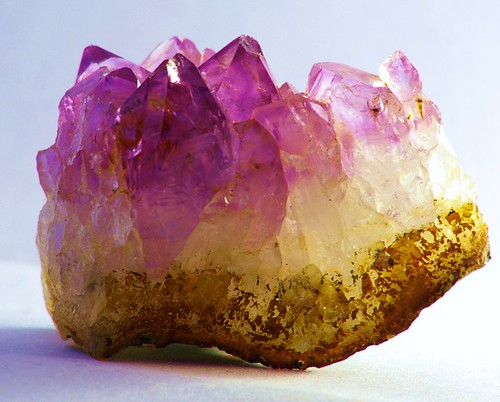
Being...ahem....a rock nerd at the time,

Figure 2: Rocks are pretty. From tourist_on_earth

I thought that geology - no, geochemistry - might be an appropriate career choice. But so I didn't sound so crazy, I tacked on biochemistry as something similar I may also be interested in. At that time, in one of the most misled moments of my life, I thought the TCA cycle was interesting. Then:

Dad: "It's a lot easier to find a job in biochemistry"

And my decision was effectively made for me.

5 years later, I have an undergraduate degree in the subject, and pretty intricate familiarity with it. Did I make the right choice? Yes and no.

I made a right choice, though i'm sure others would have led me places just as interesting, and carried me on just as far. I couldn't have known at the time that years later I would remain interested in the subject, but I am. I had little idea what biochemistry, or any other sciences (including geochemistry) was actually like. I suspect many others finish high school in a similar situation. However, my choice was a good one. I don't doubt that I would find a niche in any of several other areas, but the one I have is just right for me.

Choices are inevitable, and sometimes lead where you can't know you're going. The trick is to adapt, to learn, and to be happy with wherever you end up.

Did I think that I would enjoy study in biochemistry? I had no idea.
Did I know anything about the subject? None at all.
Am I happy with where my education has taken me? Absolutely.
Might I have been happy in a different discipline? Probably.

Yet here I am. Ready to move on, open a new chapter of my life, and close some more doors as I go. As they shut, the path ahead becomes a little narrower, a little clearer. While those doors don't open again, the ones I walk through take me on. On to new places, new experiences, and new opportunities. I can't wait.


Figure 3: Being forced to make choices is a good thing. From Mikael Miettinen

Wednesday, January 14, 2009

The Skeptic's Guide and Perry DeAngelis; Remembering and moving forward

I discovered podcasting and other Web 2.0 stuff by and large in the summer of 2007, when I had considerable free time and a long enough trip to and from work/school to facilitate listening to a full hour of audio per day. A student from my university's Skeptic's club had posted a link to a "podcast" on a message board related to the university. The title: The Skeptic's Guide to the Universe. Not particularly versed or even really aware of skepticism, I figured perhaps the podcast was something like Douglas Adams' Hitchhiker's Guide to the Galaxy (I later discovered this was indeed no coincidence) and looked into it.


The roughly hour-and-twenty long podcast was not a story of Babelfish, Vogons, the destruction of Earth, or even towels, but instead a panel discussion of all things science, with a little criticism of Bigfoot and TV Psychics thrown in. While all the stuff about ghost hunters, aliens and astrology that the panel discusses is not of much interest to me, the science sucked me in. In the course of 8 months, I had managed to listen to all of the 120 or so (at that time) hour-plus episodes these guys put out, sucking it up like a sponge. Perhaps the best feature of the show is Science or Fiction, where the host presents three science news items, two of them real, one fictitious, and asks his panel of skeptics to guess which one is the fake*.

The show is run by the New England Skeptical Society, and started with Evan Bernstein, Perry DeAngelis, Bob Novella, Jay Novella, and the ringleader, Steve Novella. They were joined after a while by Rebecca Watson, dramatically altering the dude-to-chick ratio and making the show just that much more fun.

In August of 2007, one of the Skeptical Rogues, Perry DeAngelis, passed on. I was not sure if the podcast would continue the same and hold the same draw that sucked me in, but it did, albeit with an understandably subdued tone for quite a while.

With of 4 months when I did not have access to a computer to check out the podcast, followed by a terrible fall semester, I have fallen far behind in my podcast-listening duties. I am slowly catching up, and recently I found myself listening to the 1st Perry DeAngelis Memorial Live Podcast, SGU #169, October 11, 2008. I must say that this has by far been my favorite of the episodes I've heard, perhaps because of the differing format, but likely more just because of the laid-back atmosphere the live show produces, with two guest panelists to add to the mix as well.

If you are interested in science and/or hate creationists, you should take a look at this podcast, and I recommend the memorial as a great example to start with. Although it has a slightly different format, the topics are wide-ranging and discussions are particularly thoughtful. Check it out.


*After 100+ hearing Steve say this blip at the start of Science or Fiction, you can recite (type) it from memory

Thursday, January 8, 2009

My muse is gone....

Photo from SMN

Since I decided to ditch my pseudonym, it has been harder than ever to get something written. I'm probably being overly critical given that I now must be all the more accountable for my words. Agh. One of these days I'll get my groove back, I just need some motivation. Come on science, motivate me!